Kellen A. Kane

Kellen A. Kane, Ph.D., MPA

Assistant Professor of Instruction and Director of Undergraduate Student Success and Enrichment, LBJ School of Public Affairs, The University of Texas at Austin

  • Social policy
  • Health policy
  • State politics
  • Program evaluation
  • LGBTQIA+ politics and policy

I am a public policy scholar who studies how variation in subnational politics and policy shapes health and socioeconomic outcomes for historically marginalized communities, with particular attention to sexual and reproductive health and LGBTQ+ communities. I use econometrics, methods from applied geography, and text analysis. With Tracee Saunders and Candis Watts Smith, I am writing Unplanning Parenthood, a book on how partisan pendulum swings and policy precarity have eroded access to contraception through the federal Title X program.

At the LBJ School, I teach core and elective courses in public affairs, public management, and social policy, and I direct undergraduate student success and enrichment. Before joining UT, I was a Program Evaluator at the U.S. Office of Personnel Management, where I designed and led a multi-agency randomized controlled trial of a federal Diversity, Equity, Inclusion, and Accessibility training program and studied the uptake of the federal paid parental leave benefit and the effects of telework and remote work policies. I began that partnership as an OPM Academic Affiliate while a Research Fellow with the Better Government Lab at Georgetown's McCourt School of Public Policy.

I earned my Ph.D. in Public Policy from the University of North Carolina at Chapel Hill, where I hold a fixed-term graduate faculty appointment, and my MPA and B.S. in Cell and Molecular Biology from West Chester University of Pennsylvania.

Research

My research asks why policies meant to improve health and socioeconomic outcomes so often fail to reach the people who need them most. I trace this puzzle from the politics that shape which health and social policies get written and adopted, through the administrative variation that determines whether they are implemented as designed, to the uneven health and economic consequences that follow, even for policies with broad consensus or explicit targeting.

My work appears in Health Economics, Policy and Law, Health Affairs Scholar, Politics & Gender, the Journal of Health Politics, Policy and Law, and The Forum, and has been covered by The Economist, Forbes, and PBS and cited in a proposed rule by the U.S. Department of the Treasury. It has been recognized with APSA's Kenneth Sherrill Prize, the State Politics and Policy Conference's Thomas Carsey Scholar Award, and an award from the Society for Family Planning, and supported by the Williams Institute at UCLA School of Law.

Book projectManuscript in progress

Unplanning Parenthood: The Politics of Partisan Pendulum Swings, Policy Precarity, and Contraception Deserts

Kellen A. Kane, Tracee Saunders, and Candis Watts Smith

Americans disagree on many things, but on one issue their consensus is striking: people should be able to access birth control. President Nixon signed Title X, the only federal program dedicated to family planning, with bipartisan support in 1970, and roughly three-quarters of Americans, including majorities across party lines, support protecting access to contraception today. Yet in the post-Dobbs era, contraception access has grown more contested, and the places where people lack it, which we call contraception deserts, are growing.

Unplanning Parenthood examines this paradox: a policy domain with near-universal public support that has nonetheless been eroded through bureaucratic rule changes, intergovernmental conflict, and partisan polarization. We argue that partisan pendulum swings at the national level, the nationalization of political parties, and high-stakes power struggles across levels of government together produce policy precarity, destabilizing the reproductive health care that Title X historically provided to the communities with the greatest need. The book focuses on the Trump-Biden-Trump years, when this whiplash has been most aggressive.

We pair a census-tract-level atlas of contraception deserts across all 50 states and DC with interviews with the Title X administrators who allocate the program's resources, and we use multilevel regression and poststratification to link access to health outcomes.

PublishedHealth Economics, Policy and Law, 2026Open access

The Changing Landscape of PrEP Deserts in the United States

Kellen A. Kane

Pre-exposure prophylaxis (PrEP) is a critical intervention that greatly reduces the risk of HIV transmission, yet limited access to prescribing providers continues to constrain uptake in the United States. This study examines how geographic access to PrEP providers changed between 2020 and 2023 and identifies areas with limited access, referred to as PrEP deserts. Using the Integrated two-step floating catchment area method, this study finds that despite widespread gains in PrEP access, five states experienced increases in the total population living in PrEP deserts. Additionally, more than 5 million residents in states designated as priority jurisdictions under the Ending the HIV epidemic initiative gained geographic access to PrEP providers between 2020 and 2023. However, improvements were uneven: in some states, communities of colour experienced declining access and remain disproportionately represented in PrEP deserts. These findings highlight persistent geographic and demographic disparities in HIV prevention infrastructure despite recent federal efforts to expand PrEP availability.

Maps of PrEP deserts in Kentucky in 2020 and 2023, with deserts eliminated and newly created between those years
PrEP deserts in Kentucky, 2020 and 2023. Click for the full figure, including deserts eliminated and created.
PublishedHealth Affairs Scholar, 2026Open access

Implementing Title X: Policy Design, Administration, and Geographic Access to Care

Tracee M. Saunders, Kellen A. Kane, and Candis Watts Smith

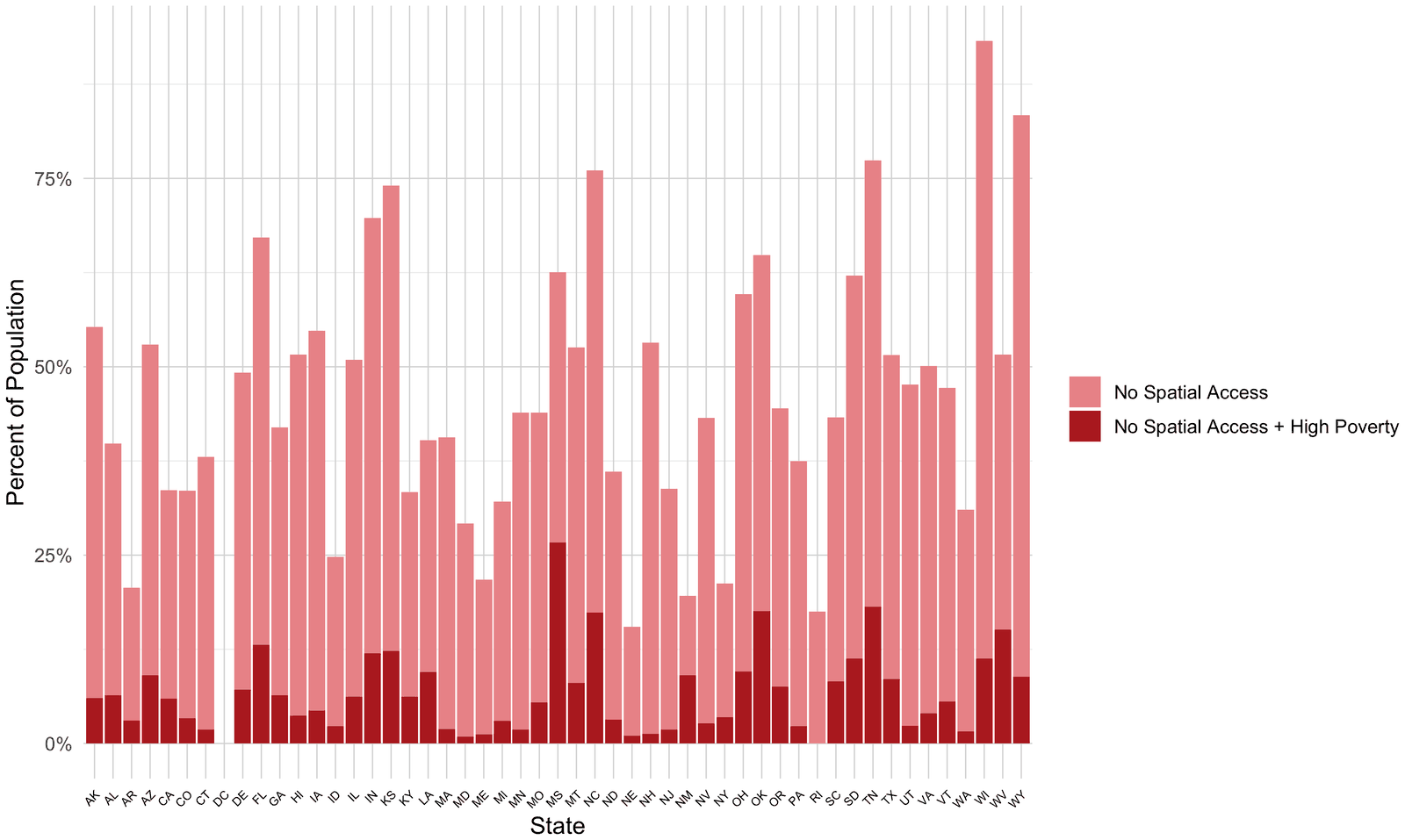
Title X of the Public Health Service Act is a critical federal program—the only one dedicated exclusively to providing affordable, confidential, evidence-based reproductive health care to low-income populations, yet its capacity to fulfill this mandate depends on political, administrative, and fiscal decisions made across multiple levels of governance—from Congress and federal regulators to state and regional grantees and their sub-grantee clinic networks. This study assesses geographic access to Title X-funded clinics across all 50 states and the District of Columbia in 2024, a period with significant program and regulatory disruption. Using the Integrated Two-Step Floating Catchment Area (I2SFCA) method—which employs road-network-based drive time thresholds calibrated to urban–rural context—applied to 2024 clinic locations and census-tract-level demographic data, we identify a confluence of spatial and nonspatial barriers to Title X. Findings reveal widespread and substantial gaps in geographic access, a challenge faced by people across all racial groups, rural and urban residents, and individuals with low incomes. These findings offer a precise geographic account of where Title X's reach falls shortest—documenting the ramifications of policy retrenchment and establishing a baseline against which future policy changes can be measured.

Bar chart of the share of each state's population living in a Title X contraception desert in 2024, ranging from under 20 percent to over 90 percent
Share of each state's population living in a contraception desert, 2024. Click to enlarge.
PublishedPolitics & Gender, 2022

Contraception Deserts: The Effects of Title X Rule Changes on Access to Reproductive Health Care Resources

Candis Watts Smith, Rebecca J. Kreitzer, Kellen A. Kane, and Tracee M. Saunders

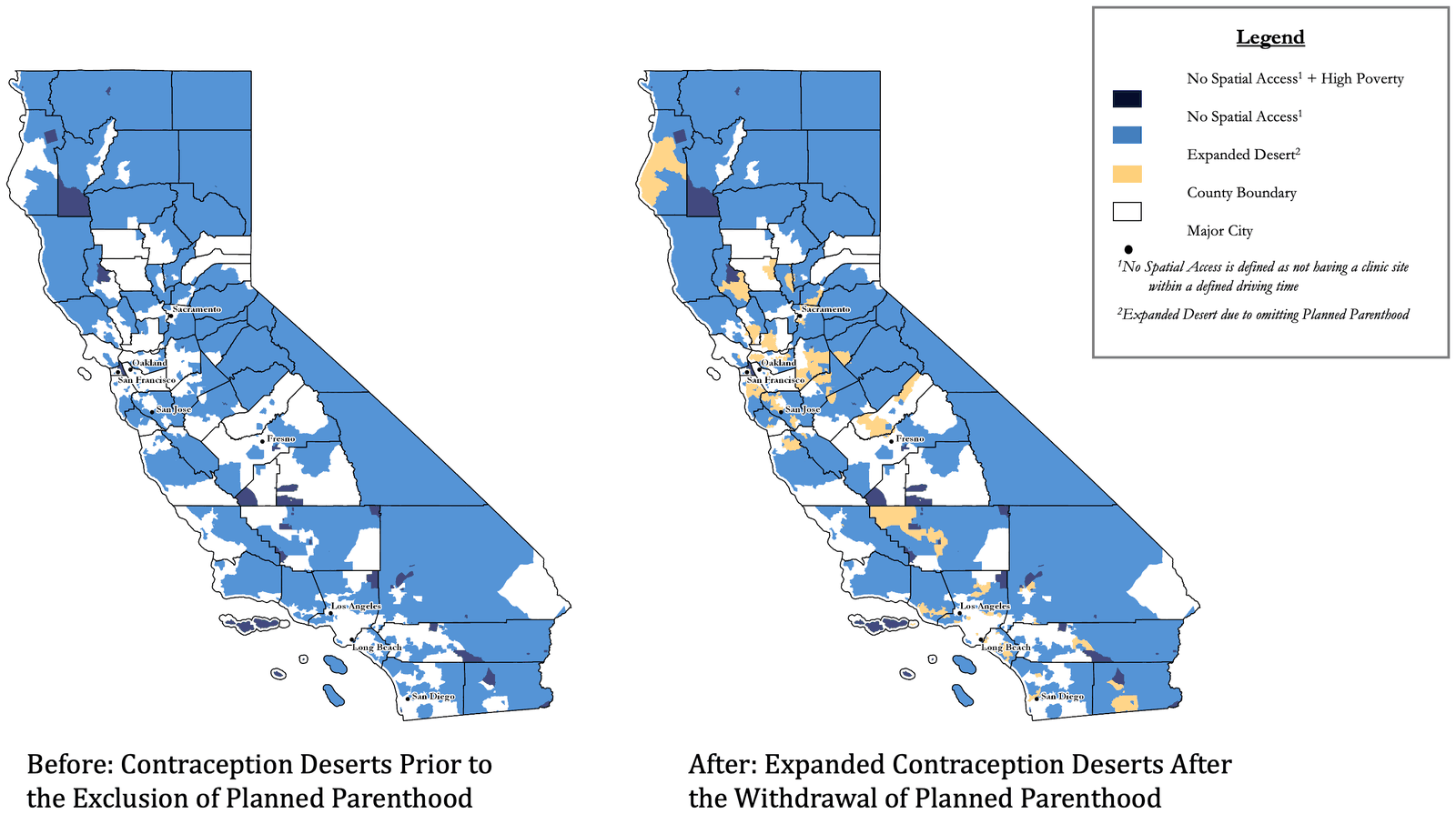
Historically, access to contraception has been supported in a bipartisan way, best exemplified by consistent congressional funding of Title X—the only federal program specifically focused on providing affordable reproductive health care to American residents. However, in an era of partisan polarization, Title X has become a political and symbolic pawn, in part because of its connection to family planning organizations like Planned Parenthood. The conflicts around Title X highlight the effects of intertwining abortion politics and contraception policy, particularly as they relate to reproductive justice and gendered policy making. Family planning organizations like Planned Parenthood have responded to these battles by bowing out of the Title X network. To what extent have contraception deserts—places characterized by inequitable access to Title X—developed or expanded in response to policy changes related to contraception and reproductive health? What is the demographic makeup of these spaces of inequality? We leverage data from the Office of Population Affairs and the U.S. Census Bureau and use the integrated two-step floating catchment area method to illustrate the effects of a major change in the Title X network in 10 states. Our results reveal the widespread human ramifications of increasing constraints on family planning organizations as a result of quiet but insidious federal bureaucratic rule changes.

Side-by-side maps of California's contraception deserts before and after Planned Parenthood's withdrawal from Title X, with expanded deserts highlighted
California's contraception deserts before and after Planned Parenthood left the Title X network. Click to enlarge.
PublishedJournal of Health Politics, Policy and Law, 2021

Affordable but Inaccessible? Contraception Deserts in the US States

Rebecca J. Kreitzer, Candis Watts Smith, Kellen A. Kane, and Tracee M. Saunders

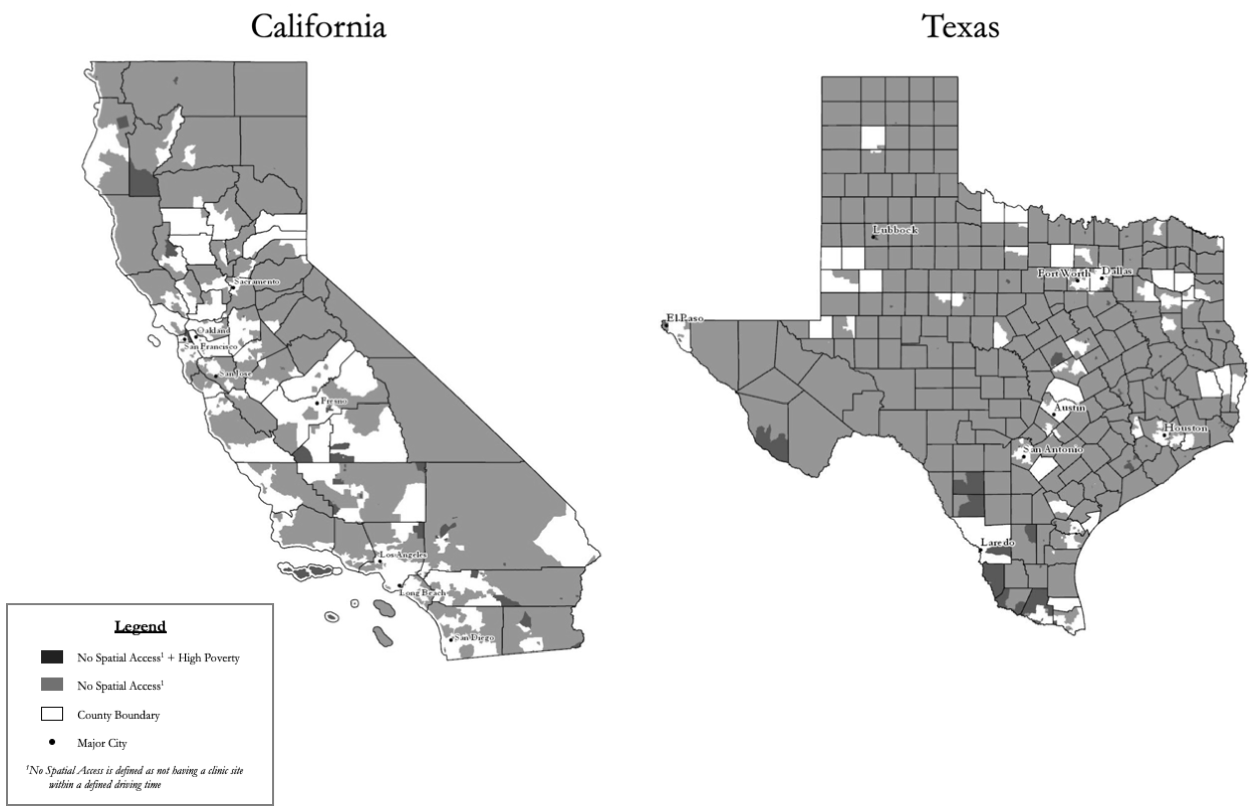
This article focuses on whether, and the extent to which, the resources made available by Title X—the only federal policy aimed specifically at reproductive health care—are equitably accessible. Here, equitable means that barriers to accessing services are lowest for those people who need them most. The authors use geographic information systems (GIS) and statistical/spatial analysis (specifically the integrated two-step floating catchment area [I2SFCA] method) to study the spatial and nonspatial accessibility of Title X clinics in 2018. The authors find that contraception deserts vary across the states, with between 17% and 53% of the state population living in a desert. Furthermore, they find that low-income people and people of color are more likely to live in certain types of contraception deserts. The analyses reveal not only a wide range of sizes and shapes of contraception deserts across the US states but also a range of severity of inequity.

The journal's second most-read article of 2021. Covered by The Economist, Forbes, and PBS and cited in a proposed rule by the U.S. Department of the Treasury.

Maps of contraception deserts in California and Texas, 2018
Contraception deserts in California and Texas, 2018. Click to enlarge.
PublishedThe Forum, 2019

The Evolution of Morality Policy Debate: Moralization and Demoralization

Rebecca J. Kreitzer, Kellen A. Kane, and Christopher Z. Mooney

Scholars of morality policy have built an extensive literature surrounding these issues, which often are associated with unusual political behavior. Early studies aimed at explaining this behavior but avoided defining a “morality policy” explicitly, typically by focusing on issues that appeared obviously to pertain to morality, like abortion and LGBTQ+ rights. Drawing on the existing morality policy scholarship and classic theories of public policy, we argue that no public policy is inherently moral. Rather, policies may be “moralized” or “demoralized” over time, not due to any intrinsic characteristic, but because the prominent policy frames in their debate have changed. Public opinion and its proxies, along with certain exogenous shocks, may be important in determining when a morality frame will be more prevalent. Because the distinctiveness of morality policy lies in the discourse surrounding it, scholars should examine the behavior and attitudes of relevant advocates in these debates, rather than relying on aggregate data and making assumptions about intrinsic policy characteristics.

Book chapterInterest Group Politics, 10th ed., Rowman & Littlefield, 2019

Whose Opinion Matters? The Role of Elite Actors and Interest Groups in Setting the Abortion Agenda

Kellen A. Kane, Rebecca J. Kreitzer, and Emily U. Schilling. Edited by Burdett Loomis and Anthony Nownes.

Examines how interest groups shape the abortion policy agenda before legislation is ever introduced.

Working paperPresenting at APPAM, November 2026

The Effect of Conversion Therapy Bans on Youth Mental Health and Suicidality

Kellen A. Kane and Brennan Mange

Conversion therapy, a widely discredited practice that attempts to change a person's sexual orientation or gender identity, remains legal for minors in many states. Using survey data from the Youth Risk Behavior Survey and mortality data from the National Vital Statistics System, we estimate the effect of state bans on conversion therapy for minors on LGBTQ+ youth mental health and suicidality. We find that conversion therapy bans decrease the suicide rate among middle- and late-adolescent individuals, particularly among males.

Working paper

Credits Where They Are Due? Health Effects of Expanded State EITCs for LGBTQ+ Individuals

Kellen A. Kane

The Earned Income Tax Credit is frequently held up as one of the most effective anti-poverty tools in social policy. Exploiting variation in the timing and generosity of state EITC supplements, I assess its health effects for individuals in same-sex households. While EITCs show no aggregate health effect for same-sex households relative to different-sex households, specific subgroups at the intersections of race, gender, and household composition are falling through the cracks, particularly in self-reported mental health. The findings point to a mismatch between the credit's design, whose generosity scales with dependents, and the distinct structural factors that shape poverty for LGBTQ+ people.

Supported by the Williams Institute at UCLA School of Law.

Working paper

Queer-ying State Legislatures: A Latent Variable Approach to Measuring Queer-Friendly State Legislative Districts

Kellen A. Kane

Who holds power in a legislature shapes which health policies are even considered possible. Using an original dataset of openly LGBTQ+ state legislators, I build a new measure of district queer-friendliness. Districts that elect LGBTQ+ legislators tend to be more liberal, more college-educated, higher-income, and less religious, and the measure identifies districts likely to elect an LGBTQ+ legislator that have not yet done so. Drawn from my dissertation, which received APSA's 2022 Kenneth Sherrill Prize, I am extending this measure through the most recent election cycles.

Work in progress

In preparation

The Evolution and Influence of Pro-Life Interest Group Model Legislation

Digitizing the full corpus of Americans United for Life's annual Defending Life publication since 2006, I trace how fill-in-the-blank model bills move from an advocacy organization into state law, shaping the options lawmakers consider before public debate begins.

In preparation

The Effects of ACA Rating Area Restructuring on Rural Insurance Markets: Evidence from Texas

with Lillian R. Hudgins (undergraduate coauthor)

In preparation

The Effects of Queer-Inclusive Sex Education Curricular Requirements on High School Student Outcomes

with Brennan Mange

Teaching

My teaching draws on my own path into higher education from a Title I high school and on my years in federal service. I want every student to connect theory to the contested politics of real policy debates, take an active part in class rather than passively receiving content, and leave with the professional skills public affairs work demands.

4.82Foundations of Public AffairsFall 2025, 92 of 94 students
5.00Introduction to Social PolicySpring 2026, 29 of 29 students
4.94Public Management (graduate)Spring 2026, 18 of 18 students

Overall instructor rating on a 5-point scale, each above the LBJ School average.

What students say

Dr. Kane is one of one when it comes to inclusive, experienced and engaged professors at LBJ. He constantly went above and beyond to make sure the class was prepared and aided in succeeding at every step.
Public Management, Spring 2026
Dr. Kane is an amazing instructor and his way of speaking about complex topics truly makes you want to pay attention even if the topic area is not of your interest. He cares deeply for our learning and enjoyment in his class.
Introduction to Social Policy, Spring 2026
He created a welcoming and engaging environment that made me look forward to attending each session. He also did an excellent job of explaining complex or dense concepts in accessible ways.
Public Management, Spring 2026
One of the most effective aspects of the course was how approachable the professor was. That made the learning environment feel comfortable, supportive, and open, which helped my learning more than anything else.
Foundations of Public Affairs, Fall 2025
I think that the course and assignment structure was very beneficial to learning how concepts of public management apply directly to the jobs that people do.
Public Management, Spring 2026
The different assignments, like the book report and the social policy in the news assignments that allowed us to apply what we learned in class to real world situations were the most effective in helping me retain information.
Introduction to Social Policy, Spring 2026
The professor truly cares about his students and makes sure we have a good understanding of each assignment before submitting it.
Foundations of Public Affairs, Fall 2025

The University of Texas at Austin

  • P A 301Foundations of Public Affairs SyllabusFall 2026, Fall 2025
  • P A 325Introduction to Social Policy SyllabusFall 2026, Spring 2026
  • P A 359Public Affairs InternshipFall 2026
  • P A 384DPublic Management (graduate) SyllabusSpring 2026

University of North Carolina at Chapel Hill (Prior)

Instructor of record

  • PLCY 220The Politics of Public Policy SyllabusSummer 2021, 2020

Recitation instructor

  • PLCY 101Making Public PolicyFall 2020

Teaching assistant and graduate research consultant

  • PLCY 365Sexuality, Gender, and Public PolicySpring 2022
  • PLCY 220The Politics of Public PolicySpring 2021
  • PLCY 581Research Design for Public PolicySpring and Summer 2020
  • PLCY 210Policy Innovation & AnalysisFall 2018 – Fall 2019